
This week From the Field, Patrick Canales discusses fall burn-down and leveraging the market by cleaning up your fields in the fall. Travis Hofslien gives tips about minimizing harvest losses and maximizing your profits during harvest.
Posted on
Join Jon Lantz and Spencer Schroeder this week From the Field as they talk about what they are seeing for quality and yield as harvest kicks off.
As always, make sure to contact your local agronomist with any questions you may have. Stay safe!
Posted on
By Joe Slosarczyk, Key Account Sales Manager
There are some key factors in proper hybrid/variety selection to successfully prepare for the 2022 planting season, as well as some new technological advancements that will be available to us for this next season and beyond. In this second part of our 2-part series, we would like to discuss some of the key factors in proper hybrid/variety selection to successfully prepare for our 2022 planting season.
Tools for Success
Proper seed selection takes careful consideration around the details to set us up for success for the following year. We will try to dive into a few of the important selection attributes and how to utilize different tools to achieve success.
There are many basic but important factors that go into seed selection. A few would be crop rotation, desired relative maturity, tillage system, nutrient management system, disease spectrum and fertility levels. First, we need to determine the maturity window for the particular crop you are intending to grow as it pertains to your specific environment. This will also help us better dial in hybrid maturity characteristics and harvest management considerations. We then need to consider if the hybrid/variety will be following a rotated or host crop. This will help us determine the right genetics for the rotation, the correct disease characteristics needed, and select the proper traits to protect our crop. Next, we need to take into consideration your specific tillage system. By knowing the tillage program, we can then properly place the hybrid/varieties based on emergence scores, fertility characteristics of the tillage system and aid in proper residue management. Following that, we need to discuss past and present disease spectrum factors for your area. This will help us not only pick the correct genetic characteristics for your particular farms, but also discuss potential seed treatment options and in-season management decisions to optimize your chosen genetics. The last basic factor will be to determine your fertility levels and your overall management system as to how we will deliver specific nutrients like nitrogen, sulfur, potassium, phosphorous and various micronutrients for the chosen genetics/system. All these basic factors make up the pillars and foundation to sound seed selection.
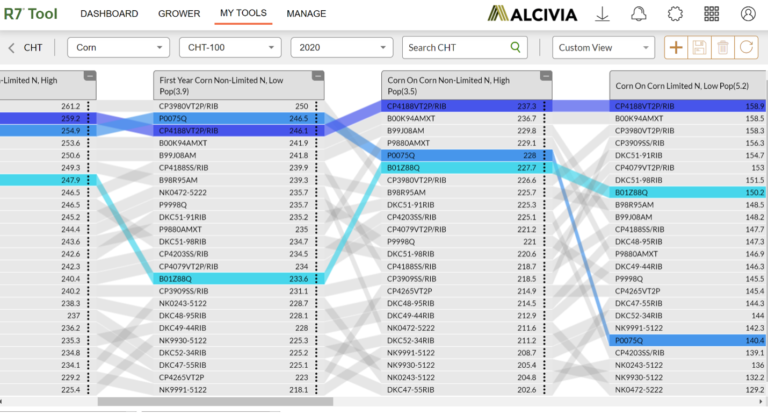
Once we have started our building blocks for success, we can then further dive into the finer details to hone in on the right seed choices. Some of the finer details could include your hybrid’s response to additional/late season nitrogen, response to increased population, response in fungicide and ultimately the yield goals for your farm. Fortunately, we have a great tool at our disposal to evaluate all those factors. This tool is Winfield United’s R7 Tool and Answer Plot system. This system that spans across the United States and encompasses high quality local data gives us sound data to provide all those characteristics including yield performance by environment. By choosing the right population, the correct nitrogen management, and potential fungicide management decisions, we can then start to get laser-focused on placing and managing the best choices for your particular system.

Variety Selection
Now, let’s dive into the proper variety on selection on soybeans. There are a few key elements to consider when choosing the best soybean portfolio for your farm. These would include maturity, tillage system, herbicide system, row width and disease environment.
Maturity depends on a few factors. These would include your geographic location, intended planting date, desired harvest date and if we are going to seed any crops after soybean harvest. Your particular tillage system has an impact on how we choose varieties. Depending on your tillage system, we can then make decisions on variety characteristics such as plant architecture, disease resistance, and herbicide options, along with other agronomic characteristics. Once we have determined our tillage system, we can then move onto the best options for your herbicide management program. This will affect the recommendation on the type of traits that would be most desired to ensure success in controlling your particular weed environment. ALCIVIA has great options for both the E3 Enlist System and the Xtend Flex System. Lastly, we can discuss your particular row width and disease spectrum. They both have an interaction together, and deciding which diseases are a potential detriment on your farm will help us choose the best variety to defend against those diseases. Putting all these factors together will give us the best opportunity to achieve the goals you have put in place for your farm.
At ALCIVIA, we realize how important it is that we are choosing the correct hybrid and management style that best fits your particular farm. We work hard to understand each of our hybrid’s unique characteristics and then truth those characteristics in the field throughout our territory. We have a great relationship with our vendor partners to keep our skills sharp and make sure you have the best support staff available. We take your seed selection very serious and look forward to the opportunity to help you reach success in 2022.
Posted on
This week From the Field, Greg Springer and Andy Beck discuss how soil sampling and VRT assist in keeping you on budget and making sure your crop gets what it needs.
As always, make sure to contact your local agronomist with any questions you may have. Stay safe!
Posted on
By Joe Slosarczyk, Key Account Sales Manager
There are some key factors in proper hybrid/variety selection to successfully prepare for the 2022 planting season, as well as some new technological advancements that will be available to us for this next season and beyond. In this 2-part series, we will focus on new technologies for 2022.
SmartStax Pro with RNAi Technology
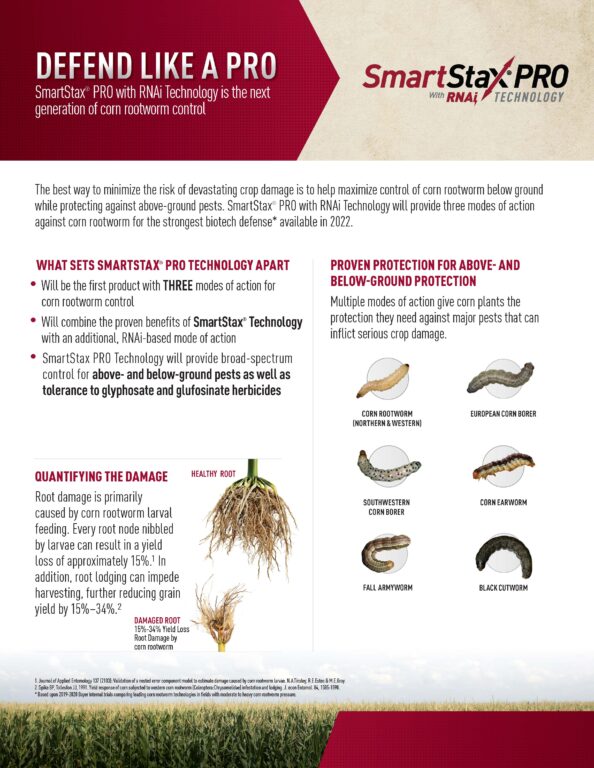
For this season, we have a few new technologies that will be available to us that are extremely exciting and will give you, the producer, some additional tools to manage rootworms and introduce us to a new hybrid system in general. The first technology that we would like to highlight is SmartStax Pro with RNAi technology from Bayer Crop Science. Since the introduction of transgenetic trait technology, we have been relying on multiple different BT modes of action to control the most devastating pest in corn, corn rootworm. While these technologies have delivered control for us since their introduction, as pest pressures evolve, crop rotations change, and management practices continue to progress, we have started to lose efficacy in certain areas when trying to control corn rootworm. For the past few seasons leading up to 2021, we had relatively low corn rootworm pressure in many of our trade territories. However, due to favorable conditions entering our 2021 season, we have seen a resurgence of corn rootworm pressure across our trade territory with record beetles being trapped and root-feeding for many to be an all-time high. It couldn’t have been better timing for the introduction and launch of SmartStax Pro than 2022.
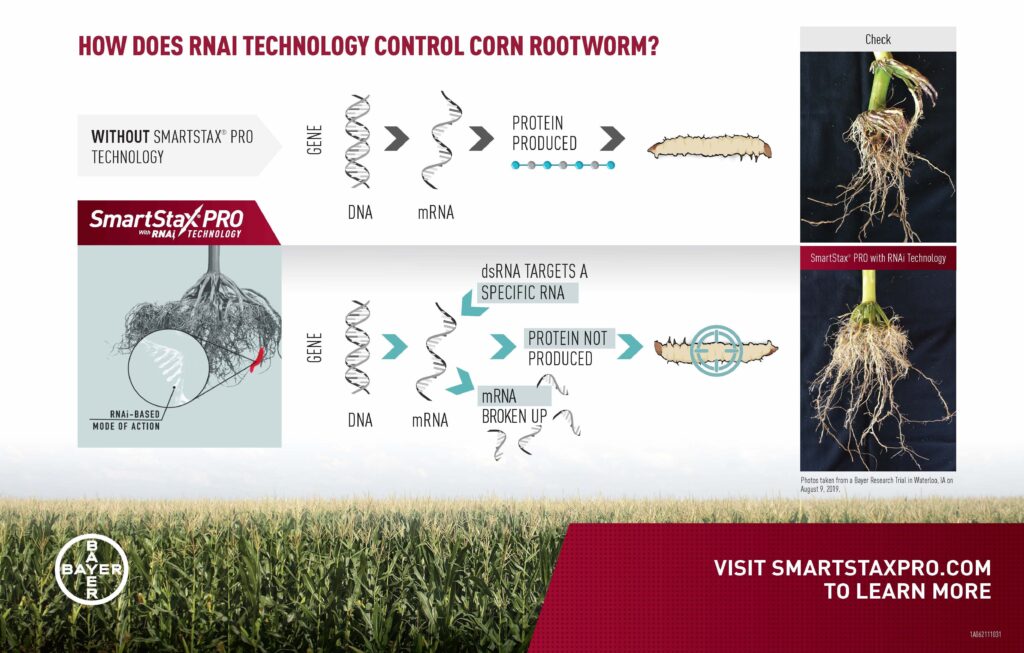
So, what makes SmartStax Pro different than previous traits and how can we utilize it as a tool in our pest management program moving forward? SmartStax Pro takes the current SmartStax Technology (2 BT modes of action against corn rootworm) and adds a third brand new mode of action RNAi technology. This new RNAi technology interferes with the corn rootworm’s ability to create a specific protein essential for life. Because of this technology advancement, we now have a non-BT mode of action to enhance our rootworm control in corn while coupled with the SmartStax technology. This technology will be available at ALCIVIA, and while supply in the initial launch year will not be determined until late 2021, we would encourage you to engage in discussion with your local ALCIVIA agronomist to prepare for the launch moving into 2022.
Short Stature Corn
The second exciting new technology that will be entering the market will be the “short stature” corn system also from Bayer Crop Science. This corn system will take proven genetics paired with a native trait to produce a shorter statured plant. There will be a few key benefits to this new system of corn. First will be improved standability and lodging tolerance. Second, this cropping system will allow us better access to in-season management of crop nutrients, fungicides, cover crops, and other applications. Third, this technology will potentially optimize water, essential nutrients, and land management practices. While 2022 will be a limited launch, 2023 is the anticipated full launch of the product line to the marketplace. If you would like to learn more about “short stature” corn or see it in person, please reach out to your local ALCIVIA agronomist.
At ALCIVIA, it is our mission to bring our customers innovative and responsible solutions for their farms. We are very excited about the new technology advancements that are currently entering the marketplace. At the same time, we want to bring these new technologies to your farm in a responsible manner to ensure that they are managed properly to maximize their effectiveness for your operation’s system and help you to better achieve your goals.
Next week, we will then discuss the key factors in choosing hybrids for your farm, the tools we have available to fine-tune our selection, and ultimately have a laser focus on hybrid/variety selection to fit your management system. Until then, thank you for taking the time to learn about this year’s upcoming advancements and we look forward to assisting you in your seed decision-making process for 2022.

This is the first part of a 2-part series regarding seed selection, placement, and new technologies for the 2022 crop year. Look forward to the second part soon!
Posted on
This week From the Field, Jordan Suhr discusses how seed selection can help you throughout the crop year and give you a hardier crop.
As always, make sure to contact your local agronomist with any questions you may have. Stay safe!
Posted on
There are a few management practices that can be evaluated for use in maximizing your fertilizer investment as it relates to soil analysis and yield.
First, start by making sure you have current soil sample data which may include the need to sample as soon as the crop is off. Include micronutrient analysis for some of the fields you sample. Macronutrient availability and absorption can be enhanced in the presence of certain micronutrients. Consider sampling on a 2.5- or 1-acre grids to place nutrients where they will be most beneficial.
Adopt and utilize variable rate seeding and variable rate nitrogen and sulfur application to maximize efficiency and save money on seed and fertilizer. Raising pH to an optimal level will enhance nutrient uptake in your crop. Consider using fall-applied elemental S or gypsum to supply some sulfur in layers for the 2022 crop. Gypsum and elemental S prices have not gone up as other fertilizer materials have. Split applications of nitrogen and sulfur will improve efficiency of utilization. Consider growing hybrids that are efficient converters of nitrogen to yield.
If you are a livestock producer or have access to manure from a neighbor, test the manure and take credit for the nutrients supplied to the land. Inject or incorporate manure to preserve the nutrients you apply. Plant cover crops this fall that will supply nutrients that your 2022 crop can benefit from. Remember to take nitrogen credits as you rotate from soybeans or hay crops to corn this season. Contact your ALCIVIA Agronomist and Precision Specialist to set up variable rate liming, fall and spring fertilizer applications, or to help you better understand the tools available to you. Below is a chart that explains the availability of many micro and macronutrients as they relate to PH.

Summer fill of 28% UAN is available at a good price for those who have tanks available to store material over winter. Booking product with your ALCIVIA agronomy salesperson locks the price in when executed against price increases through the fall, winter, and spring. Prepaying expenses is your best opportunity to lock in the lowest price available at the time you do it. Make sure you book or prepay enough product to cover your needs for 2022. All indications including global market, domestic supply, as well as an attractive grain market look to support strength in the fertilizer market and the unlikelihood of significant reductions in pricing. Included below is a nutrient removal chart as it relates to yield.

Posted on
Join Bob Galdi and Terry Zimdars this week From the Field as they discuss moisture testing your silage corn before harvest, and using technology to test silage quality.
As always, make sure to contact your local agronomist with any questions you may have. Stay safe!
Posted on
Join Justin Travis From the Field this week, who discusses field scouting for weed pressure and how it can impact your buying decisions for the 2022 crop year.
As always, make sure to contact your local agronomist with any questions you may have. Stay safe!
Posted on
This week From the Field, join Paige Behrens and a special guest as they discuss the importance of adjuvants to your return on investment.